
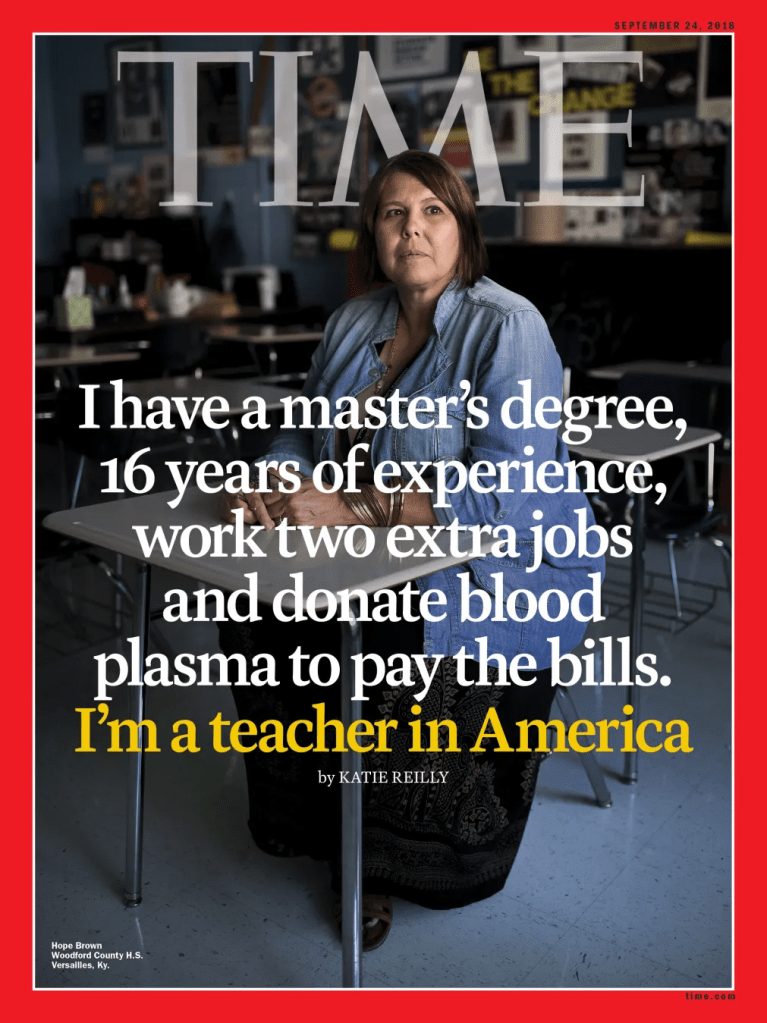
Scrolling through Instagram I saw an TIMES cover “I Work 3 Jobs And Donate Blood Plasma to Pay the Bills.’ This Is What It’s Like to Be a Teacher in America.” Although from 2018 in 2024 the struggle is still just as real. The comments sent me over the edge. “But you get summers off,” “Then get another job,” “WOW.” Here’s the thing as a teacher who left the classroom Post-COVID, the solution should not be get another job, we only get paid for the time we are in school despite often working over the summers, and students deserve quality candidates and you have to pay for quality.
Hope Brown’s story is not just one of financial struggle; it’s a poignant reflection of a system failing its most dedicated servants. As she juggles multiple jobs and even sells her own possessions to make ends meet, Hope embodies the dedication and sacrifice that many educators across America undertake every day. Yet, despite their unwavering commitment to shaping the minds of future generations, teachers find themselves undervalued and underpaid in a profession that is essential to the fabric of society.
The rallying cry of teachers demanding fair wages, better benefits, and increased funding for public education reverberates across the nation. It’s a cry born out of decades of neglect, where the value of education has been overshadowed by political agendas and fiscal austerity measures. The statistics are stark: teachers earn less, in real terms, than they did over two decades ago, while the pay gap between educators and other professionals continues to widen.
But the issue extends beyond salaries. It’s about the very fabric of our education system fraying at the seams. Schools are underfunded, resources are scarce, and teachers are burdened with unrealistic expectations and bureaucratic hurdles. The erosion of support for public education, fueled by misguided policies and a lack of investment, threatens to undermine the future of our children and our nation.
In 2018 and 2019, the Red for Ed movement gained unprecedented momentum, with strikes and protests spreading from state to state, capturing the attention of the nation. The strikes in Los Angeles and Chicago, in particular, showcased the power of collective action, as educators and school workers united to demand not only better pay, but also increased resources for students, smaller class sizes, and support staff like nurses and counselors. These strikes were more than just labor disputes; they were battles for the soul of public education, waged against years of underfunding and neglect.
But then came the pandemic—a global crisis that upended every aspect of society, including education. Schools closed their doors, and teachers were thrust into the uncharted territory of remote learning. Overnight, the dynamics of education were transformed, as educators struggled to adapt to virtual classrooms and students grappled with the challenges of learning from home.
For the Red for Ed movement, the impact of the pandemic was profound. The momentum that had been building for years ground to a halt as teachers shifted their focus to the immediate challenges of teaching during a pandemic. The traditional forms of protest and collective action that had been so effective in the past were no longer feasible in a world of social distancing and remote work. Teachers answered the call put down their protest and threw themselves into triaging learning loss.
But perhaps the most devastating consequence of the pandemic was the exacerbation of existing inequalities in education. As schools moved online, the digital divide became glaringly apparent, with students from low-income families and marginalized communities disproportionately affected by a lack of access to technology and internet connectivity. The very students that the Red for Ed movement had been fighting to support were now facing even greater barriers to learning.
Investing in education is not just a moral imperative; it’s an investment in our collective future. We spent on business loans and We must prioritize the well-being of our teachers, ensuring they have the resources and support they need to thrive in their profession. This means fair compensation, adequate funding for schools, and respect for the invaluable work that teachers do every day.
 Classroom to Corporate