

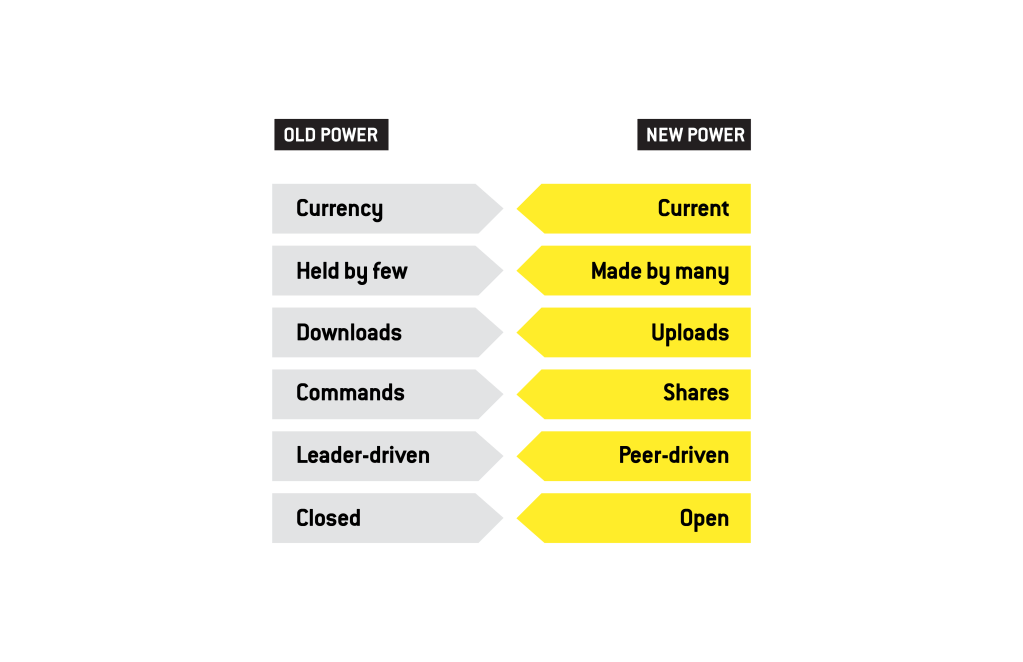
How do we seize the power and influence needed to succeed amidst the chaos? Recently I finished “New Power: How Anyone can Persuade, Mobilize, and Succeed in Our Chaotic Connected Age.” We will explore how these new power dynamics can be harnessed by individuals in a variety of contexts, from entrepreneurship to activism, and provide practical tips on utilizing these strategies for success. “New Power”, developed by authors Jeremy Heimans and Henry Timms, presents a vision of power that differs drastically from the traditional top-down models. It indicates a shift in influence, characterized by participation collaboration, and ongoing engagement. This new power paradigm empowers individuals by leveraging the networks and interconnectedness engineered by technology.
In the past, power resided in centralized organizations or influential individuals who dictated the discourse and controlled the flow of information. However, with access to unprecedented amounts of information, power has become increasingly decentralized. Ordinary individuals can now connect, build communities, and establish their own authority. New power principles highlight the importance of mobilizing the crowd and harnessing collective intelligence. Platforms such as Kickstarter and GoFundMe allow anyone to rally support and fund ideas that resonate with a wider audience, revolutionizing the way projects are financed. Building online communities and engaging with their members through interactive content can bolster support and inspire action. Gone are the days when one could influence others through one-sided communication. Traditional mediums such as radio and television were broadcast-centric and limited in terms of dialogue or audience involvement. Today, influence is created through active participation, personal branding, and relatable storytelling.
Authenticity is key when seeking to persuade others in this chaotic connected age. As individuals have become more skeptical of traditional marketing tactics, establishing genuine connections has become increasingly important. Leveraging social media and engaging in honest conversations nurture trust and foster relationships with an audience, providing an opportunity to shape opinions and influence decisions. Social movements can now be sparked and sustained through harnessing the collective power of groups. The #MeToo movement and the Black Lives Matter movement vividly demonstrate the potential for influence and change that arises when individuals united by a common cause utilize the tools available to them. The core is built around community and common purpose not core individuals.
The emergence of New Power has significant implications in the professional corporate world. It shifts the traditional dynamics of power, influence, and decision-making, empowering individuals and fostering collaboration on a broader scale even in business to consumer. This shift in power dynamics opens up new opportunities for innovation and disruption, as seen in the example of Tesla. The traditional automobile industry was dominated by established car manufacturers, but Tesla, with its innovative electric vehicles and tech-focused approach, has challenged the industry norms. By leveraging new power principles such as community engagement and crowdsourcing, Tesla has been able to build a loyal customer base and drive the transition to sustainable transportation. For example, in 2016 Tesla’s crowdsourcing of its 70,000-odd customers allowed the company to amass far more passenger miles than Google’s small fleet of professionally driven cars has done. Tesla logs about 1 million miles a day; Google has logged some 1.4 million miles since it started testing autonomous cars in 2009. Today still a luxury brand Tesla’s business model is not built on the pagentary of scarcity. A Tesla can lease for $429 per month allowing participation in Tesla’s purpose: to accelerate the advent of sustainable transport by bringing compelling mass-market electric cars to market as soon as possible.
In traditional organizations, power is largely concentrated at the top, with leaders having control over decisions and resources. New power, on the other hand, redistributes power to a broader range of stakeholders, including employees, customers, and communities. With the redistribution of power, organizations can tap into the collective wisdom and creativity of their members. The transition from old power to new power serves as a linchpin for substantial organizational metamorphosis and lays the groundwork for popular methodologies like design thinking, agile, and DevOps. These methodologies embody the principles of decentralization and active engagement inherent in new power dynamics. Design thinking, for instance, centers on a human-focused, iterative strategy that encourages cross-functional teamwork in creatively addressing intricate problems. In the realm of agile methodology, the emphasis on adaptability and iterative development aligns seamlessly with the principles of new power, emphasizing transparency and collective decision-making. DevOps embodies the principles of new power by transforming the traditional dynamics of software development and IT operations. In contrast to the traditional siloed and sequential approach, DevOps promotes a culture of collaboration, shared responsibility, and continuous feedback loops. In the context of new power, these principles emphasize decentralization and active participation at all levels of the development and operations processes. Importantly, this shift towards new power not only enhances collaboration and efficiency but also correlates with positive business outcomes, including increased adaptability to market changes, faster time-to-market, and improved overall organizational resilience.
The connected age has ushered in a new era of power dynamics that favor participation, collaboration, and connectivity. With the rise of social media and accessible technology, individuals now have the opportunity to influence and succeed in unprecedented ways. The chaotic connected age has transformed the dynamics of power and influence. With “New Power”, individuals have the opportunity to unlock their potential, create change, and craft narratives that resonate with larger audiences. By understanding and harnessing the principles of new power, anyone can become a force to be reckoned with. Remember, never underestimate the impact of your voice when armed with the right strategies and an empowered mindset.
 Classroom to Corporate