
When it comes to uncommon industries that shape the world around us, general contracting often remains a hidden gem. Nestled within the vast construction sector, general contractors play a pivotal role in turning architectural dreams into tangible structures. Today, we dive into the intriguing world of general contracting, exploring the greying of the construction industry, the earning potential it offers, and the journey to becoming NASCLA certified. Despite some barriers to entry, being a contractor does not require a college degree, and if you have ever managed a home improvement project, think that, but on a larger scale.
Picture this: you’re strolling through a bustling city, admiring the magnificent skyscrapers that kiss the sky. Have you ever wondered how these towering structures come into existence? That’s where general contractors come in. They are the masterminds behind the scenes, orchestrating the symphony of construction projects from start to finish. But what exactly does a general contractor do In essence, a general contractor acts as the conductor of a grand symphony, harmonizing a diverse array of professionals, subcontractors, and suppliers to bring a construction project to life. From coordinating the architects, engineers, electricians, and plumbers to managing budgets, timelines, and permits, the general contractor is the linchpin that holds everything together.
However, as fascinating as the world of general contracting may be, it faces a significant challenge: the greying of the construction industry. Over the years, the construction workforce has been gradually aging, with fewer young professionals joining the field. I heard a curious statistic. For every seven construction professionals that retires, one takes their place. This poses a looming concern as experienced contractors retire without enough successors to fill their shoes. The greying trend has sparked a call for fresh talent to step up and breathe new life into the construction industry.
Now, let’s talk numbers. What can aspiring general contractors expect in terms of earning potential? The good news is that the construction industry offers substantial opportunities to make a comfortable living. The average annual wage is $69,731, with a range of $12,955 to $339,343. However, it’s worth noting that the earnings can vary significantly based on factors such as location, experience, and the size and complexity of the projects undertaken. With dedication and expertise, general contracting can provide a rewarding and financially promising career path.
To embark on this journey, one crucial stepping stone is becoming a qualifier. A qualifier is a person who has the technical knowledge of their construction practice like that doors, when fully opened, shall not reduce the required width by more than 7 inches. My favorite qualifying certification is the NASCLA (National Association of State Contractors Licensing Agencies) certification. Recognized in 16 states and the Virgin Islands, this prestigious certification signifies a general contractor’s competency and knowledge of a range of construction. It’s a commercial contracting test. It’s an investment in one’s professional growth that opens doors to a wider range of opportunities and allows for the pursuit of projects in multiple states.
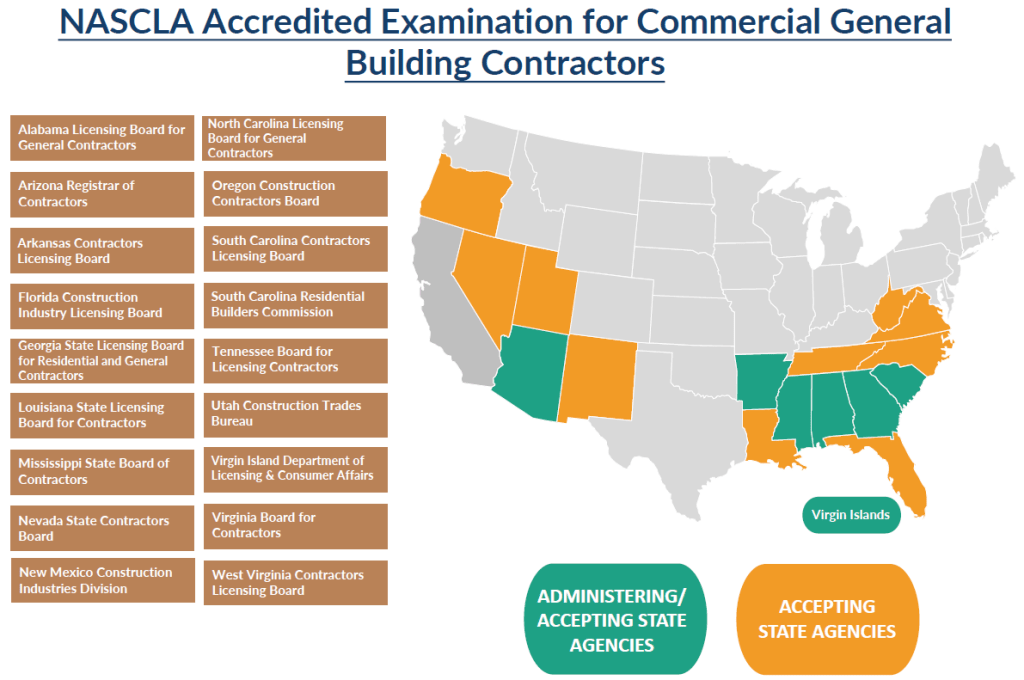
The NASCLA exam is an open book test that requires about $2000 dollars worth of books. The actual exam details are below.
| Exam Information | |
|---|---|
| Exam Fee | $130 |
| Number of Questions | 115 |
| Passing Score | 70% or 81 Questions |
| Time Limit | 330 Minutes |
The test consists of the following:
General Requirements (25 Questions)
Site Construction (15 Questions)
Concrete (6 Questions)
Masonry (4 Questions)
Metals (6 Questions)
Wood (5 Questions)
Thermal and Moisture Protection (5 Questions)
Doors, Windows, and Glazing (4 Questions)
Finishes (5 Questions)
Mechanical and Plumbing Systems (6 Questions)
Electrical Systems (3 Questions)
Procurement and Contracting Requirements (31 Questions)
Now, let’s zoom in on North Carolina, known for its vibrant construction industry and growing economy. If you have your sights set on becoming a general contractor in the Tar Heel State, you’ll need to meet specific requirements. The primary requirements for licensing include, completing the application, be at least 18 years of age, possess good moral character, meet the minimum financial requirement based on the limitation of license you are applying for, and successfully completing an examination based on the desired classification of license. For a limited license, the lowest level of license in NC you must simply have current assets that exceed the total current liabilities by at least seventeen thousand dollars ($17,000) or have a total net worth of at least eighty thousand dollars ($80,000); you can also obtain a surety bond for $175,000.
Becoming a general contractor may seem like an arduous path, but the benefits are undeniably enticing. Not only do you get to be at the helm of remarkable construction projects, but you also have the opportunity to shape the physical landscape of cities and communities. The pride that comes with seeing a vision materialize before your eyes is unmatched. The greying construction workforce presents a call for new talent, making it an opportune time to explore a career in this field. So, grab your hard hat, don your entrepreneurial spirit, and let the music that is construction begin!
 Classroom to Corporate