
Abbott Elementary, the NBC comedy series, has gained popularity among viewers for its entertainment value and its representation of diversity in schools. One of the most prominent characters on the show is Gregory Eddie, portrayed by Tyler James Williams, who started as a substitute teacher but became a full-time teacher at the school. Now it is no scientific fact in 2021, 1.3% of teachers were black males, and in 2022, 2% were black males. Quite the coincidence. All jokes aside, let’s talk about the effect of Black males in the classroom.

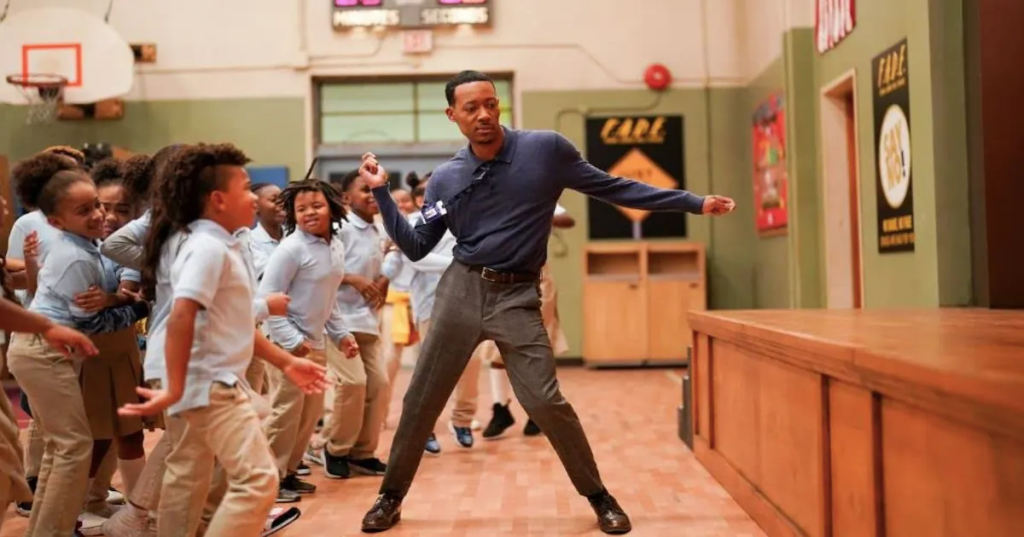
Eddie’s character is portrayed as a no-nonsense person with unique quirks that make him stand out from other characters. For instance, he’s a picky eater; I mean, who doesn’t like pizza. He hates gardening but can’t stand idly by as people murder plants. Despite his quirks, he adapts to his student’s needs, including adapting his teaching style, seeking out counsel from veterans, and attempting to connect with them to understand their culture better. Unlike Janine’s class, Mr. Eddie’s students, from the beginning, embrace order and structure by following his lead. Even going so far as to look to him to see if they should dance during a school assembly. Humans use mirror neurons from infancy into adulthood to observe and learn from their social interactions. In the absence of positive role models, black children may mirror and build relationships that are less than healthy.
In The Heringer Report’s “Schools can’t afford to lose any more Black male educators” Devna Bose says:
Black boys’ emotions and behavior are often misinterpreted by teachers, the majority of whom are White women. Nationally, Black boys are overassigned to special education — judged by teachers who don’t understand their behavior, or too quickly decide that their behavior is unusual instead of digging deeper. Then they’re put into isolated, self-contained classrooms, or disciplined frequently.
When Black boys have Black teachers, it prevents that, allowing teacher and student to often connect on a deeper level.
Devna Bose
Take the graph below; studies have shown the expulsion rate for black male students by black female and male teachers is statistically significantly different from white female teachers.
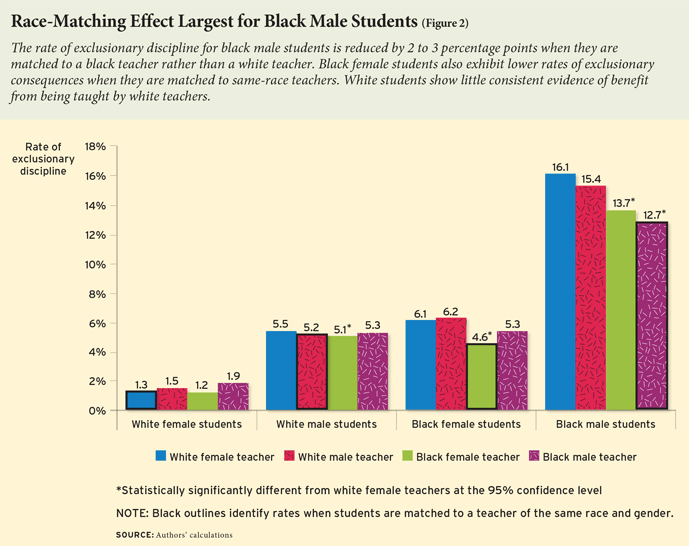
Anecdotally I noticed this when I was teaching. The majority of IEPs for black students were initiated by white female teachers. At one point, a school I was at launched a disciplinary database, and it was found write-ups were disproportionately written by white female teachers. As one of the teachers with the lowest write-ups and highest proficiency, I was often asked how?
The top 3 reasons for suspensions, 1. Insubordination 2. Disruptive Behavior 3. Fighting. A lot of the behaviors that my white counterparts wrote up, I redirected. Case in Point- Insubordination was the one I hated: “Insubordination a refusal to comply with school rules and regulations or refusal to obey reasonable directions or instructions of school personnel”. So often, teachers would say he was cursing or cursed me out. Most teachers respond to a child cursing with “that’s against school rules” or “you need to stop cursing.” To a preteen and teen that feels confrontational. As an adult that feels confrontational. Imagine walking down the street and someone told you, “stop cursing” while you were talking to your friend. You’d roll your eyes and keep doing what you’re doing. And if they said something else… you would snap.
How would Miss Mayes handle it?
Student walks in throws down bookbag
THEM: “I had a crazy fucking weekend?”
ME: “Really? What did you do that was so crazy? Give us the PG version please, no cussing. We’re all ears, shoot.”
THEM: “My bad (launches into story)”
See, it’s that easy.
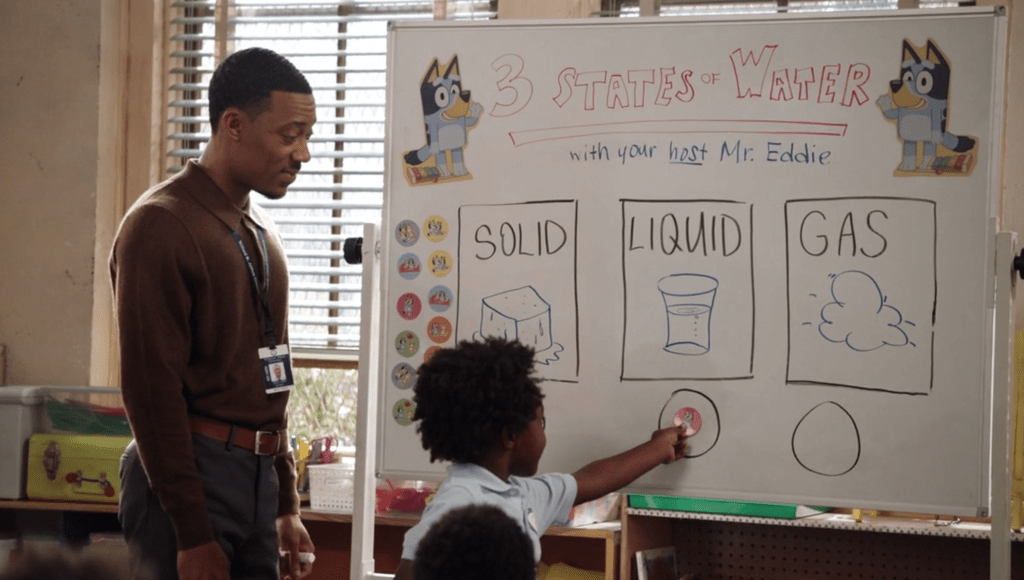
Back to Mr. Eddie. Mr. Eddie’s character highlights the importance of positive and compassionate social associations. In one episode, he engages a disruptive student by capitalizing on their interest in Bluey in presenting his content. He adapts to the needs of students to provide a better learning experience. Sure at first he sends them to the office and Ava has to break it down to him that discipline isn’t always the answer, but his solution when he solutions has flawless execution. His approach not only makes the learning process more engaging but also proves to be effective for the student. The look on his students face is almost reverent.
Eddie’s character highlights the significance of representation in schools. As a Black man in a position of authority, he provides a role model for Black students, demonstrating that success is attainable for everyone, regardless of race or background. The portrayal of Eddie’s character provides a positive representation of a black male teacher who cares about his students and goes above and beyond to help them succeed.
Gregory Eddie’s character in Abbott Elementary highlights the importance of adapting to the needs of students and representation in schools. The show’s emphasis on diversity and inclusion in schools is a powerful message that should be widely promoted.
 Classroom to Corporate