

As someone who worked in education, it’s a hard pill to swallow when you realize that some high school graduates can’t read. It’s a problem that many of us may not be aware of, but it’s a reality for a surprising number of students. It’s a symptom of a larger problem that exists within our educational system. One that can leave students behind and ill-prepared for the challenges that lie ahead.It’s not as if these students are simply unable to read at a high level. Many of them struggle to read at even a basic level. They may be able to read simple words, but when it comes to reading comprehension, they’re at a loss. The reasons for this can be numerous, but it often comes down to a few pivotal moments that can shape a student’s educational journey. It is heartbreaking to see high school graduates who cannot read. This issue is not only a symptom of a larger problem within our educational system, but also a failure of the system to provide adequate support to students. This is how it often goes:
From the time he started kindergarten, Miguel struggled with reading. His parents, who worked long hours to make ends meet, didn’t have the time or resources to help him. They thought he’ll learn in school and it’s his teachers job to help him. And his teachers, who had large class sizes and limited resources, often focused on getting through the curriculum rather than addressing Miguel’s learning needs.
As Miguel progressed through elementary school, his struggles with reading continued. He was often placed in lower-level reading groups and given simplified assignments, which only furthered his feelings of inadequacy and frustration. Despite this, Miguel tried his best and worked hard in his other classes, such as math and science.
By the time Miguel reached middle school, his reading difficulties were more pronounced. He had trouble understanding textbooks and often had to rely on classmates to help him with assignments. His teachers recognized his struggles, but with limited resources and a heavy workload, they struggled to provide him with the support he needed. They gave him a tutor, but they met once a week. Miguel continued to work hard, but he felt increasingly discouraged and left behind. He didn’t want to worry his parents, and as long as he got promoted his parents never really thought he might need help.
As high school approached, his parents noticed a shift. Miguel was not interested in school but was popular and the teachers loved him. He learned if he could make people laugh and smile it didn’t really matter what happened in school. However, the reality was much harsher. Miguel’s reading difficulties had become severe, and he could barely read at a basic level. Despite this, he was passed along from grade to grade, with minimal interventions or support from the education system.
When it came time to graduate high school, Miguel was relieved to have made it through. But he knew deep down that he had not received the education he deserved. His reading difficulties had not been properly addressed, and he had been passed along without the necessary interventions and support.
One of the main reasons students may graduate without the ability to read is due to the lack of emphasis on foundational literacy skills in early education. Often, teachers are pressured to cover a wide range of topics and may not have the time to dedicate to teaching these foundational skills. Without a solid foundation, students will struggle to keep up with more advanced reading materials as they progress through school. Additionally, the use of standardized tests as the primary metric for measuring student success has contributed to this problem. Schools are often judged on their test scores, which incentivizes teachers to focus on test preparation at the expense of actual learning. As a result, some students are passed through the system without the necessary skills to succeed, including the ability to read at a basic level.
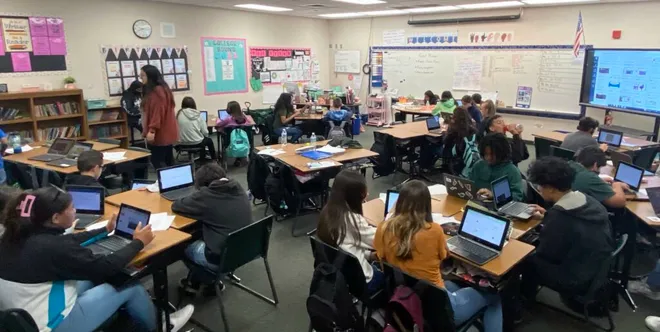
Furthermore, there is a lack of resources; the greatest is people. It is almost impossible to conduct individualized instruction in the classroom. With large class sizes and limited resources, teachers do not have the opportunity to provide personalized attention to every student. My niece went to a Title I elementary, and I remember my sister calling me mad as hell. The teacher had made my niece cry for writing her last name. This was a weird hill for the teacher to die on, but talking to them, their reason was they wanted all of the students at the same level. Most of the students in her class could not write their full name. In low-income schools the curriculum is geared towards the lowest common denominator. And as the gap widens students who still struggle with reading, below an already lowered bar, are often placed in classes with other struggling students. With so many struggling students, teachers’ aids are often not provided and are allocated to test critical classrooms to drive up scores. This can make it even harder for these students to catch up and keep up with their peers, leading to a cycle of underachievement.
In addition, it is a common misconception that students learn to read in school. Research has consistently shown that the foundations of literacy are laid in the first few years of life, long before children enter school. Beginning in infancy, children are exposed to language through their interactions with caregivers and their environment. This exposure to language plays a crucial role in shaping a child’s ability to learn to read. In addition to language exposure, a child’s early experiences with books and print also play an essential role in literacy development. When parents read to their children and expose them to a print-rich environment, they provide a foundation for literacy that can help their children become successful readers later on. Moreover, cognitive and neurological factors also play a significant role in literacy development. For example, a child’s working memory, attention, and phonological processing skills are all critical components of learning to read. These skills can be shaped by a variety of factors, including genetics, environmental toxins, nutrition, and stress. While schools certainly play an important role in teaching reading and supporting struggling readers, it is important to recognize that literacy development is a complex process that begins in infancy and is influenced by a variety of factors beyond the classroom. Without a strong foundation, students are often at a disadvantage. But the lack of emphasis on foundational literacy skills in early education, the use of standardized tests as the primary metric for measuring success, the lack of individualized instruction, the lack of funding and resources for schools in low-income areas, and the placement of struggling students in classes with other struggling students are all contributing factors. To address this issue, we need to rethink the support needed, rethink the allocation of teachers in early education, rethink standardized testing, and ensure that all students have access to the resources they need to succeed.
 Classroom to Corporate
I left high school reading at 3rd grade level,I have a learning disability.everyone gave up on me
LikeLike