
Bottom Line Up Front (BLUF)
- Transparency: Students know the expectations necessary to meet each learning goal for the class.
- Progress is Tracked: Data for each learning goal is tracked so student/parent/teacher can easily see goals mastered and those they still need to work on.
- Personalized: Teachers and students know exactly where they are in their learning, so the learning can be personalized to meet the students’ needs, including remediation for those in need and challenges for those who are ready for deeper learning.
- Focus is on the process of learning: Instead of the focus being on one final grade and one chance to submit, the focus is on the learning process used to reach mastery of the learning goals with opportunities to submit evidence to prove mastery.
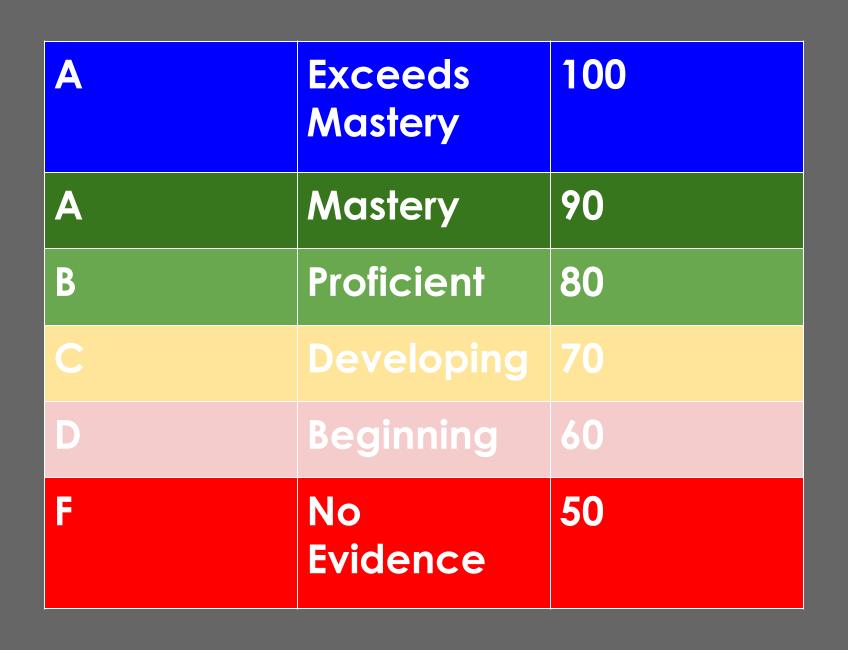
Imagine my surprise when I was at a Lunch and Learn at my graduate school and witnessed the slacked jaw awe of my colleagues as my professor discussed mastery grading like it was a novel idea. When I was teaching, it was anything but. I used mastery-based grading for all five years that I taught. I perfected the scale and practice over time. But why? Well, simply put, because it made sense.

When I first began teaching, I was informed that I would be evaluated on a sliding scale—the NC Educator Effectiveness System: developing, proficient, accomplished, distinguished, not demonstrated. In most careers, evaluation is assessed on a scale. Of course I was told it was racist, classist, etcs. but for me it was the fact that the traditional scale is not equally distributed. Let’s be honest, in most careers, if your know more than half your shit, you will be okay. If we are preparing students to be college and career-ready, then our practices should be reflective of their careers.
My focus was on how to create a conversation and how to push my highs and pull up my lows. I operated in controlled chaos. I only taught for 15 minutes, and the rest of the activities were self-directed stations while I facilitated with a watchful eye. Read it, Watch it, Write it, Organize it, Explore it, Research it, capped off with Assess it. Alternatively, Summarize, Create, Interpret, Experiment, Navigate, Challenge, and Extend followed by an assessment. The point being was students did increasing levels of difficulty, and where they stopped, I could quickly assess their level of mastery or investment. Assessments were always 10 questions and focused on application. To go a step further, if students did not like their grades on their assessment, I allowed them to submit a self-directed assignment. We would have conversations with chances to correct and expand their learning if they did not meet the criteria of mastery. It was always about the process, not the product. The simplification of scores allowed me to diagnose the problem and pull small groups during stations to remediate or extend learning.
Lift the veil on how to succeed.
Standards-aligned rubrics, simplified grade calculations, and standards-based scales and grade books make teachers’ expectations explicit and facilitate students’ understanding, ownership, and power over their grades.
As I think about my new career in Talent & Transformation, the same principles apply. HR professionals should make employer’s expectations explicit and facilitate employees’ understanding, ownership, and power over their performance? Data can be used to understand and address the gaps to transform employees to transform businesses and education. People analytics help us upskill our future and current workforce, but the process has to be interactive, clear, and visible for all parties. People need partners for better performance.
 Classroom to Corporate